
Browse Videos by Category

Colonial Era
American Revolution

The New Nation

National Expansion and Reform

Civil War and Reconstruction (Coming Soon)

Tenth Amendment Guarantees Federalist System of Government
The Tenth Amendment guarantees us a government which divides power between a distant central authority and legislatures closer to home and more in tune with local needs.

John Adams, A Diplomat in Europe
John Adams retired from Congress in November 1777 but was soon appointed as a commissioner to France, marking the start of his diplomatic career. After two years in France, Adams, on his own initiative, set off for Amsterdam, the capital of the Netherlands, to secure recognition of American independence and obtain a desperately needed loan for the United States.

Beyond the Bill of Rights – Ninth Amendment Protections
The Ninth Amendment, crafted by James Madison, reserves for the people all rights not expressly granted to the government. Tom Hand, creator and publisher of Americana Corner, explores how this visionary amendment addressed the concern that the new Bill of Rights might be construed as a complete list, and why it still matters today.

Thomas Paine’s Common Sense Inspires a Nation
To fully appreciate the novelty of Thomas Paine’s Common Sense, one must consider that all colonists had ever known was a dependency on England and a government run by the King. Now this 47-page pamphlet challenged them to consider separating from that powerful nation and replacing the King with something called a democracy.

The Eighth Amendment and Protecting the Criminally Accused
Our Forefathers knew that a person accused or convicted of a crime within the bounds of our judicial system would be relatively powerless without certain protections. To prevent harsh and arbitrary treatment by the government, the Founders created the Eighth Amendment.
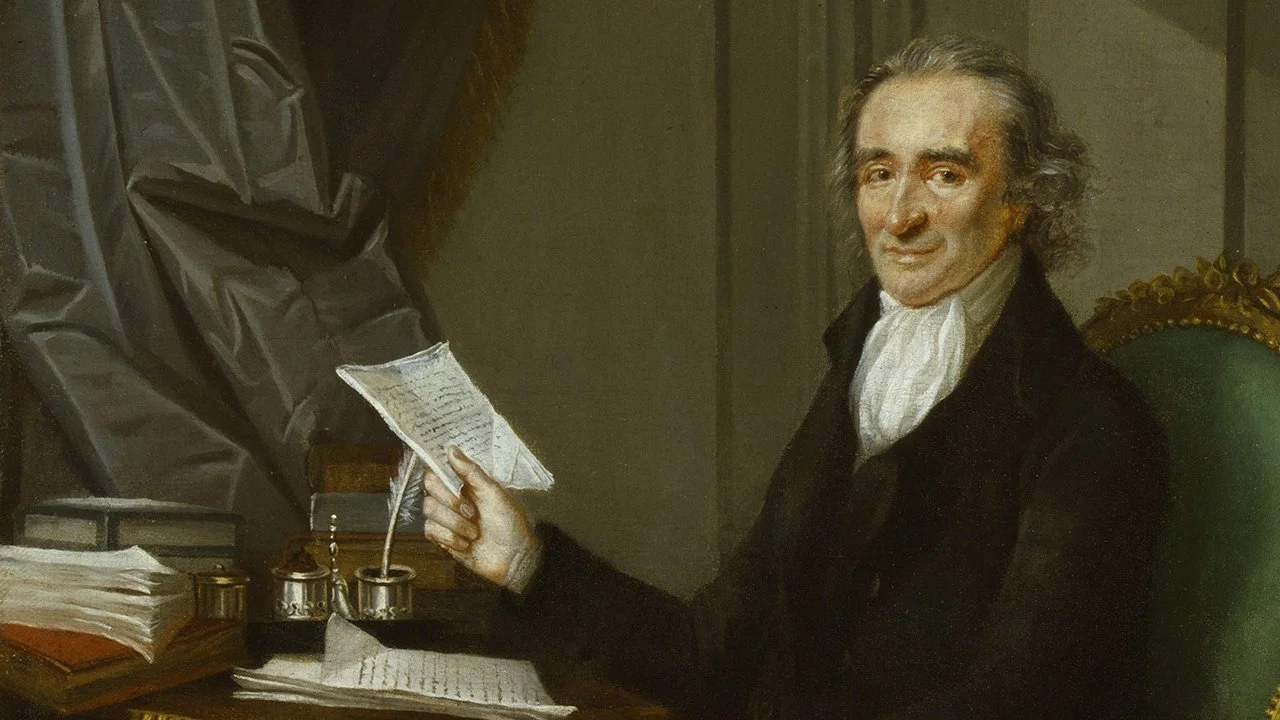
Thomas Paine, An American Revolutionary
The two most influential books of the Revolutionary era were written by Thomas Paine, an immigrant from England. Common Sense and The American Crisis shaped the American mindset like nothing else.

Fair Trials Guaranteed By the Seventh Amendment
Our founding fathers had experienced a country in which the monarchy had been both the judge and the jury. This one-sided system was terribly unfair. In response, they created the Seventh Amendment to ensure the people, not the government, decide if someone is innocent or guilty.

John Adams Dominates Second Continental Congress
Through sheer force of will and a supremely convincing explanation of democratic government, John Adams almost single-handedly convinced the Second Continental Congress to unanimously approve our Declaration of Independence on July 4, 1776.
Guaranteeing Your Rights in Criminal Proceedings
The Sixth Amendment helped usher in a new age of justice. With the various rights included in this amendment, the Founders guaranteed to all Americans transparency and fairness in criminal proceedings, and protection from an over-reaching government.

The Second Continental Congress Convenes
In 1775, despite the seemingly unavoidable conflict between the colonies and England, there was disagreement regarding our future relationship. Some, like John Dickinson, wanted to remain loyal to the King, some were undecided, and others, including John Adams, wanted to declare independence. Watch Americana Corner’s latest video and learn how the opening debates resulted in a last attempt at reconciliation, and why it still matters today.

Innocent Until Proven Guilty
The Fifth Amendment contains five separate but related rights protecting those accused of a crime. Thanks to the foresight of our Founders, we are innocent until proven guilty, and the burden to prove guilt falls on the government.

John Adams Joins the Fight for Independence
By 1773, John Adams had established a prosperous legal practice and had a fine family. He believed differences with the Crown could be and should be worked out. But after the Boston Tea Party, and England’s response, Adams became committed to the cause of independence as one of Massachusetts’ representatives to the First Continental Congress.

The Fourth Amendment, the Basis for Our Right to Privacy
It is hard to imagine any place more sacred to each of us than our home. We take for granted a natural right to privacy there, but our Founders lived in a different time.

John Adams, Boston’s Top Attorney
John Adams was one of the most respected attorneys in Boston. His highest profile case came in 1770 with the Boston Massacre trial. When no one else would take their case, Adams agreed to defend seven British soldiers accused of murdering five civilians who as part of a large mob had threatened the men.

A Little-Known Amendment, Important to Our Founders
The Third Amendment centered on a very important matter to our Founding Fathers, that of the people being forced to bear the costs of housing and feeding soldiers.

John Adams Comes of Age
John Adams, one of America’s greatest Patriots, played an important role in allowing America to gain its independence from England. His upbringing in a Puritan home had tremendous impact on his fine character and straightforward manner so frequently displayed throughout his life.

The Right to Keep and Bear Arms
The Founders recognized that securing oneself from harm was a fundamental right and made certain they guaranteed it to all of us.

The Legacy of Henry Knox
Other than George Washington, Henry Knox was the greatest soldier-statesman of the Founding Generation, and his accomplishments in the field and the halls of government are unparalleled.