
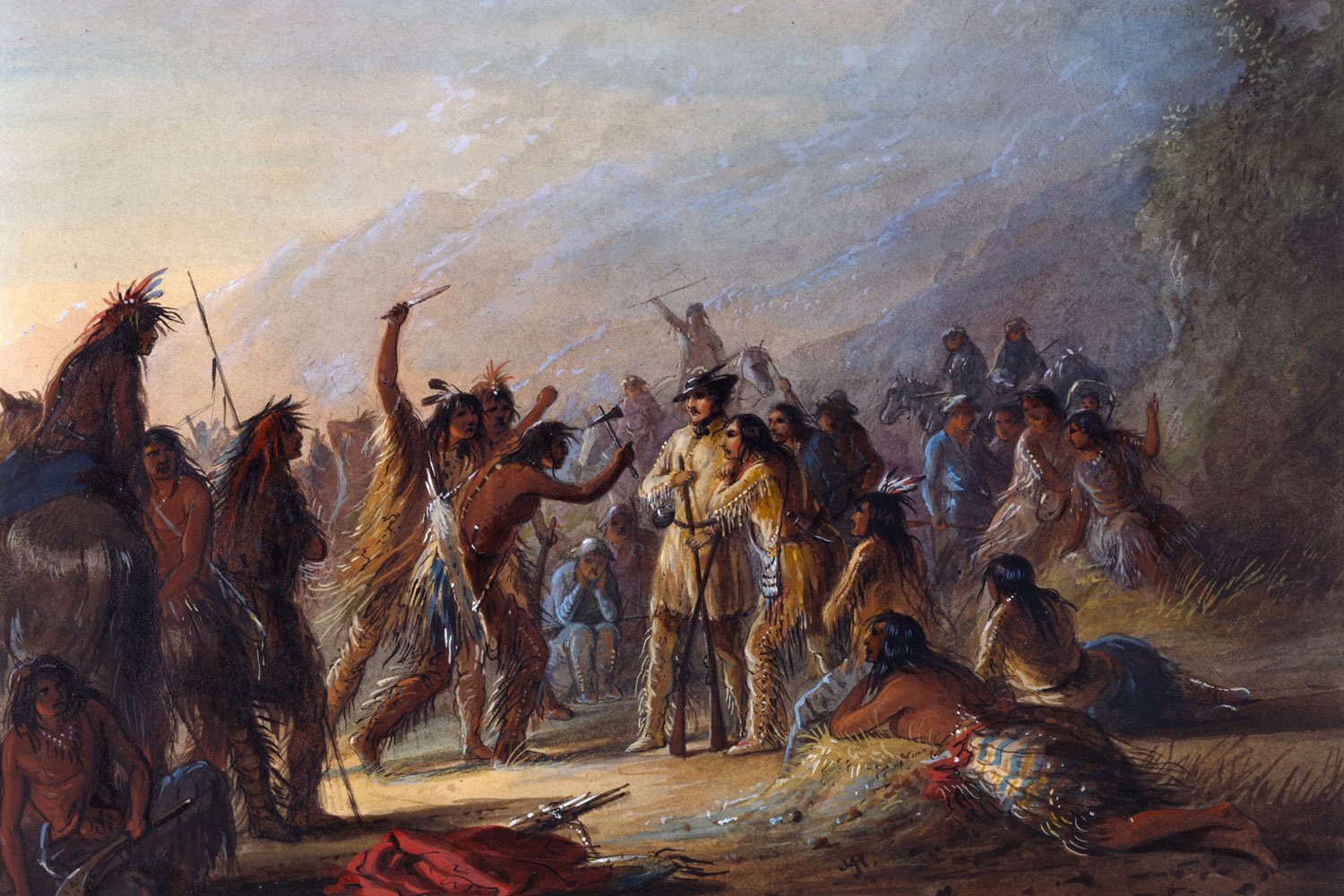
Alfred Jacob Miller. “Attack by Crow Indians.” The Walters Art Museum.
Mountain men were a breed apart and experienced dangers, harrowing escapes, and hardships that most people cannot even begin to appreciate or understand. Moreover, many of these princes of the wilderness were larger than life figures in the minds of the public and, to be sure, no less in their own fertile minds. It is easy to imagine a group of them sitting around a campfire in the dead of a Rocky Mountain winter and trying to outdo each other’s stories of the grizzlies they encountered and the Indians they fought, and they were not likely to let facts get in the way of a great story.
But that said, reality was sufficiently fascinating to amaze and impress, and many of the more noteworthy mountain men had experiences that were larger than life. Jim Bridger, who spent nearly fifty years in the mountains and blazed trails into his sixties, was one of the first to see the natural wonders of Yellowstone and the Great Salt Lake; Jedediah Smith was the first American to crisscross present-day Nevada and Utah and scale the High Sierra; Joe Walker helped blaze the California Trail that thousands of Americans followed to reach the California gold fields, and Kit Carson was a Kentuckian who went west and learned his trade on the Sante Fe Trail and seemingly spent more time fighting Apache and Comanche than trapping beaver.
And then there's the Hugh Glass story. Glass signed on with the Ashley-Henry Company in 1823 and, while hacking his way through a thicket of wild plum bushes, came face to face with a mama grizzly and a pair of cubs. The seven-foot grizzly turned on Glass and slashed and bit him from head to toe before his agonizing screams reached his companions who arrived and killed the eight-hundred-pound beast. None of his fellow trappers gave Glass a chance at surviving, but two men, a trapper named Fitzgerald and young Jim Bridger, agreed to stay with Glass to the bitter end. After three days of their death watch, it became apparent to Fitzgerald and Bridger that Indians were in the area, and thinking discretion was the better part of valor, they decided to leave Glass to die on his own, taking his rifle and other equipment, thinking Glass was beyond needing them.
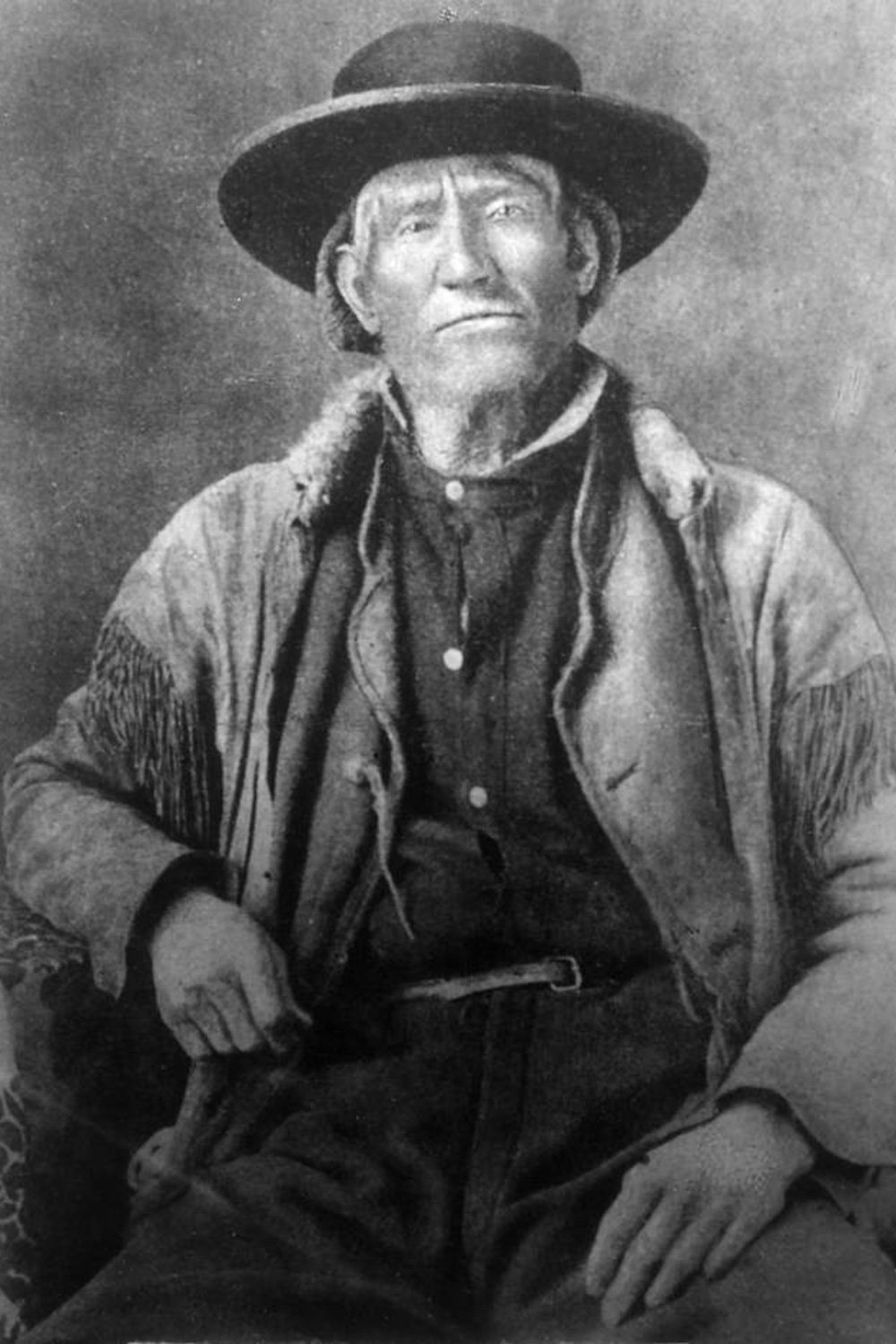
“Jim Bridger.” Wikimedia.
The two men returned to their base and informed everyone that Glass was dead and buried, but that was not the case. Somehow, Glass had managed to drag himself to a nearby stream, drink some water, and eat some of the plums on which the grizzlies were feasting, which revived him in body and spirit. Glass burned with revenge against Fitzgerald and Bridger, and that hatred gave him the strength to crawl and walk roughly two hundred miles to Fort Kiowa on the Missouri River, where he was restored to health. Shortly thereafter, Glass caught up with Fitzgerald and Bridger but didn't have the heart to shoot them and simply gave them a verbal tongue lashing.
But the most incredible story of the mountains was that of John Colter, one of the earliest mountain men, having accompanied Lewis and Clark on their Corps of Discovery from 1804 to 1806 before leaving the expedition on its homeward journey to try his luck in the mountains. Colter signed on as a trapper with Manuel Lisa, one of the early American pioneers in the western fur trade, and agreed to manage his Fort Manuel on the Yellowstone in the midst of territory controlled by Crow Indians, a tribe friendly to whites at that time. In the summer of 1809, while setting traps, Colter came upon a battle between Blackfoot and Crow Indians and joined the fight on the side of the Crow; the Blackfoot noticed Colter’s participation, and he became a marked man. A few weeks later, Colter and his partner John Potts were setting traps on the Jefferson River and were surprised by hundreds of Blackfoot, who ordered the trappers ashore. Potts refused, firing his rifle at the Blackfoot, and was killed in a hail of arrows. Colter surrendered but the Blackfoot had no intention of showing him any mercy, instead hoping to have some fun with their captive.
After chopping Potts’ body into small pieces and tossing them into the river, the Blackfoot stripped Colter, and the chief led him to a spot 400 yards away and told him to start running. Naked and barefoot, Colter knew he was literally running for his life, and under a burning sun and racing across prickly pear, Colter immediately set out. At this point, Colter was about six miles from the Madison River and thought if he reached the river he might have a chance. After running for three miles, Colter looked back and discovered that he had outpaced his pursuers except for one brave armed with a spear. Colter felt he now had a chance, but his nose began to bleed profusely from the exertion, and soon his upper body was covered with blood. Still a mile from the river and beginning to falter from the loss of blood, Colter knew it was time for something desperate, and he suddenly turned, taking the Indian by surprise. The Blackfoot stumbled and dropped his spear, which Colter grabbed and plunged through the Indian’s chest.
Colter then continued his race to the river and jumped into the Madison well ahead of his pursuers. Colter swam downstream about a mile, mostly underwater, until he came to a small island where he found a large mound of driftwood piled up on its shore under which Colter hid himself with only his nostrils above water. Meanwhile, all along the shoreline, the screaming Blackfoot searched in vain for Colter until they tired of the fun and drew off that evening. After nightfall, Colter swam another two miles downriver before making his way ashore and setting out for Fort Manuel, roughly seven days away. For the next week, Colter scaled mountain heights and crossed wide prairies, walking day and night, stopping only for brief moments of sleep, and subsisting entirely on roots and tree bark before finally reaching the safety of the fort.
But beyond the blood curdling adventures, the fur trade was a business, and the United States government wanted a part of it.
Next week, we will discuss the United States fur factory system. Until then, may your motto be “Ducit Amor Patriae,” love of country leads me.
Enjoyed this article? Share it to help others discover the great American story! Subscribe to receive a new article and video each week, delivered directly to your inbox.
Hello America!
Subscribe to receive weekly complimentary articles and videos delivered straight to your inbox.
Mountain men were a breed apart and experienced dangers, harrowing escapes, and hardships that most people cannot even begin to appreciate or understand. Moreover, many of these princes of the wilderness were larger than life figures in the minds of the public and, to be sure, no less in their own fertile minds. It is easy to imagine a group of them sitting around a campfire in the dead of a Rocky Mountain winter and trying to outdo each other’s stories of the grizzlies they encountered and the Indians they fought, and they were not likely to let facts get in the way of a great story.