
War of 1812, Part 18: Macdonough Triumphant on Lake Champlain
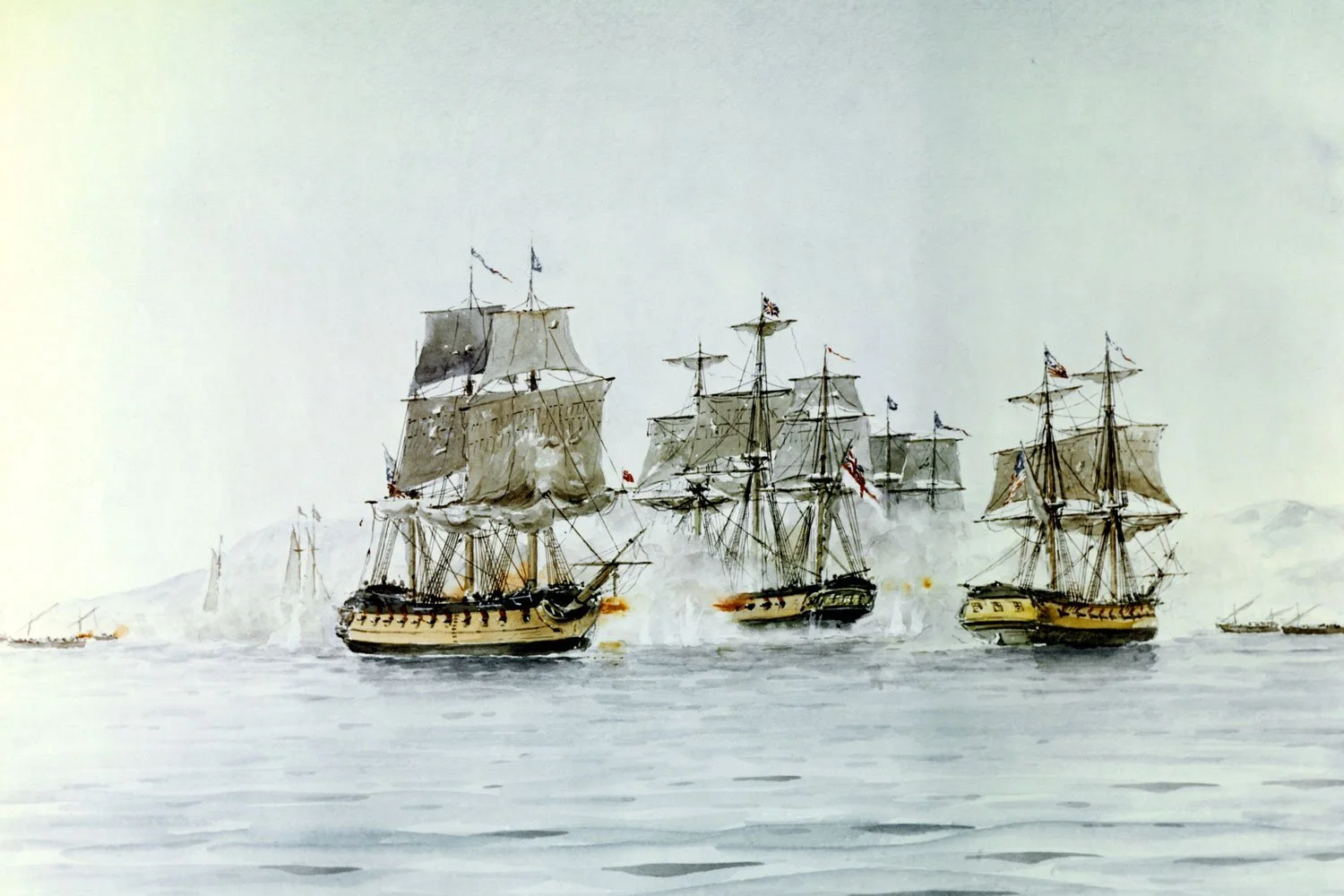
Cdr Eric Erskine Campbell Tufnell RN. “Macdonough's Victory on Lake Champlain, 1814.” Naval History and Heritage Command.
Besides the pending land battle at Plattsburgh, there was a naval battle to be fought for the control of Lake Champlain, the two-hundred-mile waterway that had served as the main invasion route for American, British, and French troops since the 1750s. In many ways, the naval contest was more critical than the land battle, for without control of the lake, invading armies could not be resupplied given the dearth of roads in that part of the country. The British fleet was commanded by Captain George Downie, temporarily detached from the Lake Ontario fleet, and consisted of his flagship Confiance, 16 guns, Linnet, 16 guns, Chubb, 11 guns, Finch, 10 guns, and twelve gunboats carrying a total of 17 guns. But Downie was unfamiliar with the officers, and the sailors were generally of poor quality, inexperienced, and poorly trained. Downie requested additional time to prepare his ships and train his men before proceeding into the battle, but General George Prevost, the overall commander, was impatient to get started and denied Downie’s request.
The American fleet on Lake Champlain was entrusted to 31-year-old Captain Thomas Macdonough, who had been in command of the Lake Champlain fleet since the outbreak of the war and chafed at the chance for glory that thus far had passed him by. Macdonough's fleet consisted of his flagship, the small frigate Saratoga (26 guns), Eagle (20 guns), Ticonderoga (17 guns), and Preble (7 guns). Macdonough also had ten gunboats in his fleet, carrying a total of 16 guns. But perhaps the greatest advantage the Americans possessed was in its commander, as Macdonough was a bright, resourceful officer who had been hardened in combat alongside Stephen Decatur in the Barbary Wars. Aware of the British advantage in long-range guns, Macdonough arrayed his four warships across the mouth of Plattsburgh Bay with his right flank covered by Crab Island and positioned his gunboats between the larger vessels. This alignment forced Downie’s fleet to face a raking fire as it entered the bay to confront the American vessels and brought him so close to the American line that his advantage in long-range guns was completely negated. Macdonough took the further precaution of prepositioning kedge anchors off the bow of Saratoga so that if the need arose, he could spin the ship 180 degrees to bring fresh, undamaged guns into the fight, essentially doubling the firepower of the ship.
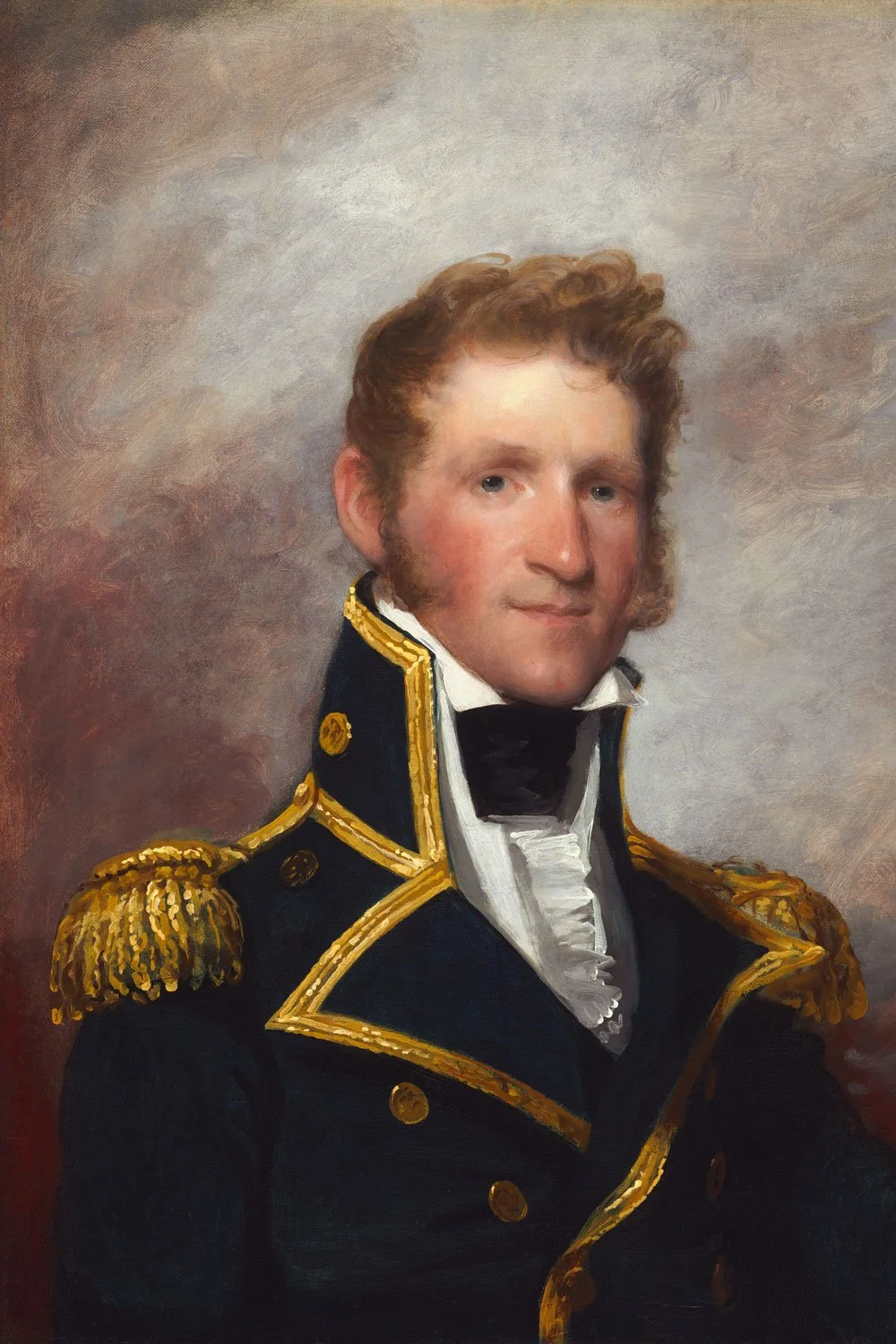
“Commodore Thomas Macdonough.” National Gallery of Art.
Around 9 a.m. on September 11, American lookouts saw the British fleet rounding Cumberland Head, and the fleets soon engaged with the two flagships squaring off. The first broadside of double-shotted 24-pounders from Confiance was devastating to Saratoga, and over forty sailors were killed or wounded in this initial salvo, but Macdonough quickly reorganized the men and began a murderous fire on the Confiance. Fifteen minutes later, a shot from Saratoga hit a 24-pounder on Confiance, which sent the gun hurtling across the deck and crushed Captain Downie, a loss that was one of the deciding factors in the battle.
For the next hour, the two fleets traded broadsides as the British ships Chubb and Finch were knocked out of action, while the American sloop Preble also withdrew from the fight. By now, Saratoga was badly damaged with all starboard guns disabled, and the outcome of the battle hung in the balance. At this moment, Macdonough's precaution of placing kedge anchors paid dividends, and he spun Saratoga 180 degrees and opened fire with his fresh larboard guns. Confiance attempted the same maneuver but failed and soon was at the mercy of Saratoga; minutes later Confiance surrendered. The other British ships followed suit, and except for a few gunboats that escaped, the entire British fleet on Lake Champlain was in American hands. During the two-hour battle, the Americans had lost 110 sailors, while the British lost twice that amount, including Captain Downie. Macdonough dispatched a message to Secretary of the Navy William Jones, “Sir-The Almighty has been pleased to grant us a signal victory on Lake Champlain in the capture of one frigate, one brig, and two sloops of war of the enemy.”
Meanwhile, General Prevost, whose plan was to coordinate his assault with the naval battle, opened with an artillery bombardment and then ordered his infantry forward. A British brigade under General Frederick Robinson gained a foothold at a ford across the Saranac River, pushing back the New York militiamen before the Vermont volunteers shored up the line. The Americans prepared to receive the next British assault, but that assault never came as Prevost had received word of Downie’s defeat. Cautious by nature and recognizing that without naval control of Lake Champlain his line of communication would not be secure and, consequently, his invasion could not succeed, Prevost called off the attack and ordered a general retreat, departing in haste that night. The Generals under his command, especially those who had served under the Duke of Wellington in the Peninsular War, were appalled at Prevost’s decision, and many in England shared that feeling of disgrace. Prevost was recalled to England and requested a court-martial to clear his name, but he died before that enquiry was held. Interestingly, the Duke of Wellington offered some support of Prevost’s actions, saying that after the fleet was beaten, Prevost made the correct decision, as naval superiority on the lakes was essential to a successful war on the frontier of Canada. But Wellington also recognized a lost opportunity and further stated that the soldiers simply “wanted this iron fist to command them.”
Perhaps the victor of Waterloo was right, but that's all in hindsight. The reality was that thanks to the courage and ability of Captain Thomas Macdonough, the great British invasion of 1814 was turned back. One could argue that Macdonough’s signal victory on Lake Champlain was strategically more significant than Perry’s on Lake Erie in 1813. Had Downie’s fleet won the day, Prevost almost certainly would have continued his assault and taken Plattsburgh, thus placing the British army in full control of the northern tier of the country. Undoubtedly, British negotiators would then have demanded, with some justification, territorial concessions including part of Maine from the United States at the ongoing peace negotiations in Ghent.
Next week, we will discuss the war at sea. Until then, may your motto be “Ducit Amor Patriae,” love of country leads me.
Hello America!
Subscribe to receive weekly complimentary articles and videos delivered straight to your inbox.
The War of 1812 was arguably the most partisan war in our nation's history, with virtually all Federalists across the country opposing what they dubbed “Mr. Madison’s War” and all Republicans supporting it. This difference in sentiment was pronounced and led to many ugly confrontations such as the Baltimore riots of 1812. But nowhere was opposition to the war more strongly manifested than in New England, the last bastion of the Federalist party.