
War of 1812, Part 16: Battle of the Chateaugay
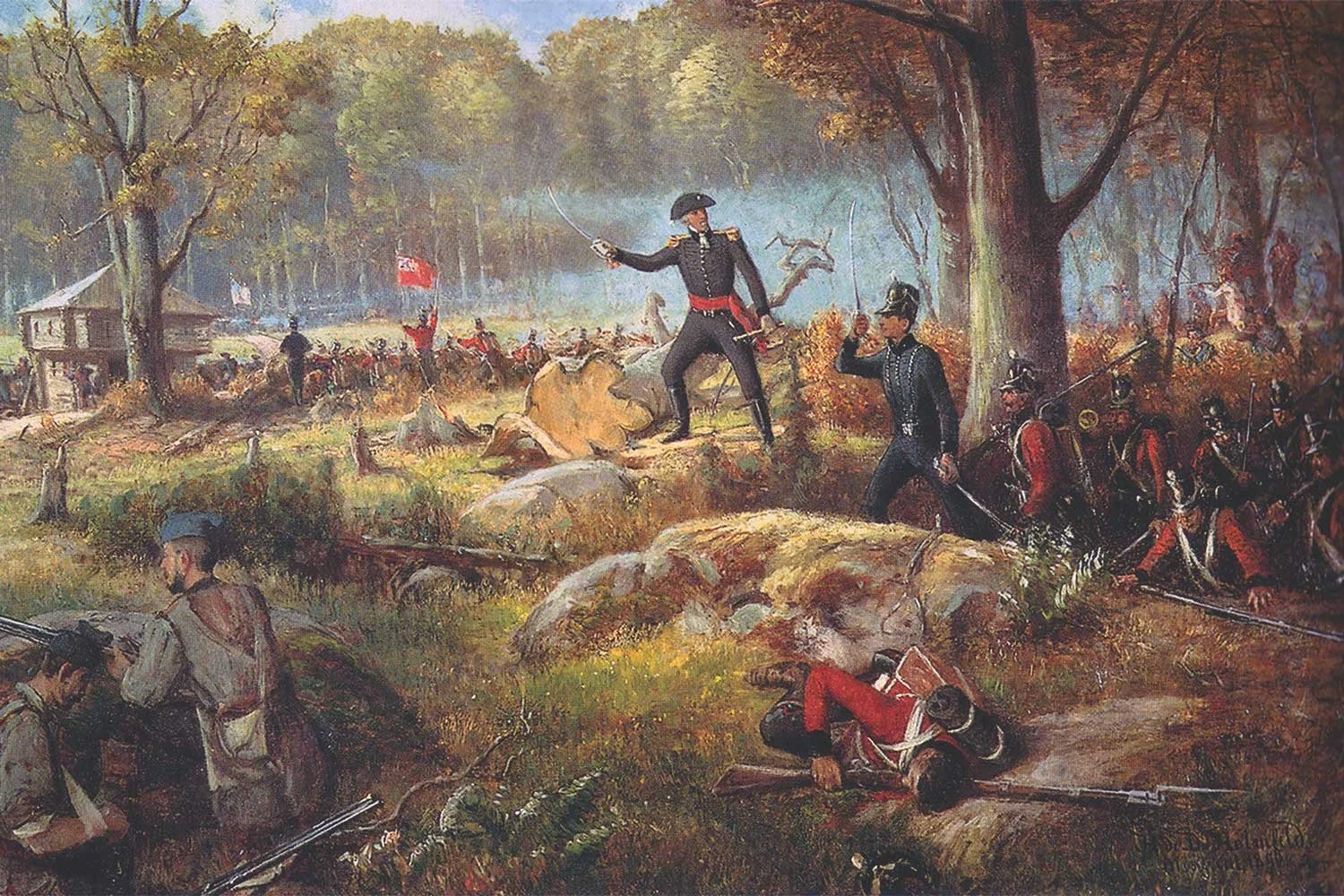
E. H. de Holmfield. “Battle of Chateauguay 1896.” Wikimedia.
When Secretary of War John Armstrong moved General Henry Dearborn from his command of the northern army to a desk position in New York and replaced him with General James Wilkinson, Armstrong also needed to find a new Major General to take over the command at Plattsburgh and Lake Champlain. Armstrong's choice for this position was Wade Hampton I, an interesting choice in that Hampton was the avowed enemy of Wilkinson, and yet the two generals would have to work hand in hand for the campaign to be successful. The results of the campaign would prove the folly of Armstrong’s choice of commanders.
Hampton was a true Southern aristocrat from South Carolina who had been serving as the top-ranking officer in the Orleans Territory since 1809. Needing a competent commander to support Wilkinson’s anticipated movement down the St. Lawrence River to Montreal, Armstrong transferred General Hampton to the Northern District to command the American army near Lake Champlain. Hampton was instructed to move down the Richelieu River and join with Wilkinson near the St. Lawrence just above Montreal, and then the combined army would assault and capture the city, thus severing the supply line to Upper Canada. But Hampton, who was a man of rigid Southern honor, despised Wilkinson for his low character and constant intrigues. As famed historian A. B. Hart wrote, “He hated Wilkinson with a fine and worthy hatred and despised him with all his ardent soul.” The two Major Generals had battled one another for years within the army officer corps, and Hampton informed Armstrong that he would only accept the position if it were a separate and distinct command. Moreover, Hampton demanded that his orders come directly from the War Department, not from Wilkinson. Armstrong agreed to these demands, and, accordingly, Hampton assumed command on July 3, 1813, joining his troops at Burlington, Vermont. But concerned that his two Generals would fight themselves as much as the British, Armstrong transferred his headquarters to Sackett’s Harbor to act as a buffer between the two antagonists.
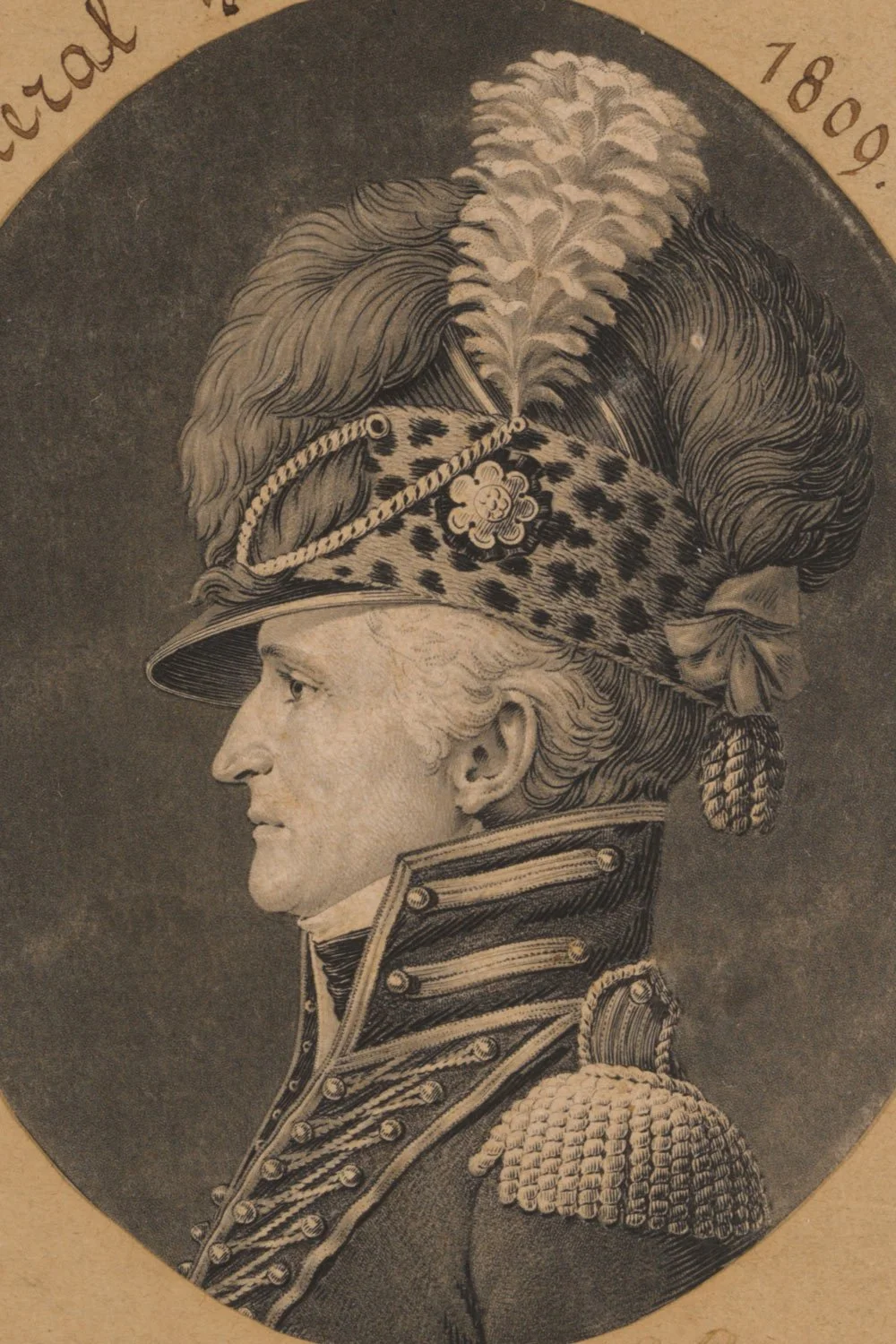
“Wade Hampton.” National Portrait Gallery, Smithsonian Institution.
Hampton had nearly 4,000 men in his new command, but they were mostly new recruits and had received little or no training, and, moreover, his junior officers lacked experience. He also had a forward base at Plattsburgh, but at this point the north end of the lake was controlled by the British, who had raided Plattsburgh earlier that summer. British naval supremacy on the lake essentially rendered Plattsburgh inaccessible to Hampton’s army until Lieutenant Thomas Macdonough, commander of the American navy on the lake, could construct a flotilla to counter the British warships. By mid-September, Macdonough had finally assembled the necessary ships to transport Hampton’s army safely across the lake and did so on September 19. The following week, Hampton moved his army fifty miles west to the Shakopee River and established his base camp at a place called the Four Corners of the Chateaugay. From this strategic position, Hampton was able to threaten both Montreal and the British line of communication up the St. Lawrence. But, as Hampton’s primary mission was to support Wilkinson's movement, Hampton was forced to wait until receiving word that his army was underway. Finally, on October 18, Hampton received a message from Secretary Armstrong that he expected Wilkinson's movement to begin shortly and ordered Hampton to move closer to the mouth of the Chateaugay to be in a better position to affect a junction with Wilkinson's army.
Hampton headed down the Chateaugay River but without his entire force, as a brigade of fickle New York militiamen refused to cross the border into Canada, the same problem General Stephen van Renssalaer had encountered the previous year on the Niagara frontier. Consequently, Hampton’s army moved forward with roughly 2,600 men, including two hundred mounted troops and ten field guns, to Spears, roughly ten miles from the St. Lawrence and fifteen from the mouth of the Chateaugay. The British force confronting the Americans consisted of 1,500 men under Lieutenant Colonel Charles de Salaberry, who established a strong defensive position behind abatis (obstacles made of felled trees) along Hampton’s route of march and positioned another force about a mile away to guard a ford across the Chateaugay.
Hampton’s plan called for Colonel Robert Purdy to circle behind the British position and capture the ford at dawn, while at the same time a detachment under General George Izard launched a frontal assault. But soon after Purdy set out on his mission, Hampton received a letter from Secretary Armstrong that contained the disturbing news that Armstrong was retiring from the theater and Wilkinson was now in charge. Armstrong's letter further informed Hampton that he was to prepare winter quarters for 10,000 men within the limits of Canada, as Armstrong felt that little could be accomplished the rest of the year. Recognizing the campaign was over, Hampton tried to recall Purdy from his movement but was unable to do so and ordered Izard's men to stand down and not participate in the pending attack. Perhaps it was just as well, because Purdy’s brigade got lost on their nighttime march and was not able to engage the British until noon on October 26. And when Purdy’s brigade finally did attack, the assault was quickly broken up, and the Americans retreated in disarray.
As it turned out, the Battle of the Chateaugay was more of a skirmish than a battle, as the Americans suffered fewer than fifty casualties while the British lost roughly half as many. But with Armstrong leaving the scene and Wilkinson still stuck at Sackett’s Harbor, Hampton retired to Four Corners, where he had started his campaign. As promised, the 63-year-old General soon resigned from the army and returned home to his plantation in South Carolina. It was a disappointing end to another disappointing campaign, and the land war of 1813 ended as dismally as that of the previous year. Only Harrison's victory at the Battle of the Thames and Perry's great triumph in the Battle of Lake Erie provided any reason for hope for the Americans for the coming year.
Next week, we will discuss the British northern offensive of 1814. Until then, may your motto be “Ducit Amor Patriae,” love of country leads me.
Hello America!
Subscribe to receive weekly complimentary articles and videos delivered straight to your inbox.
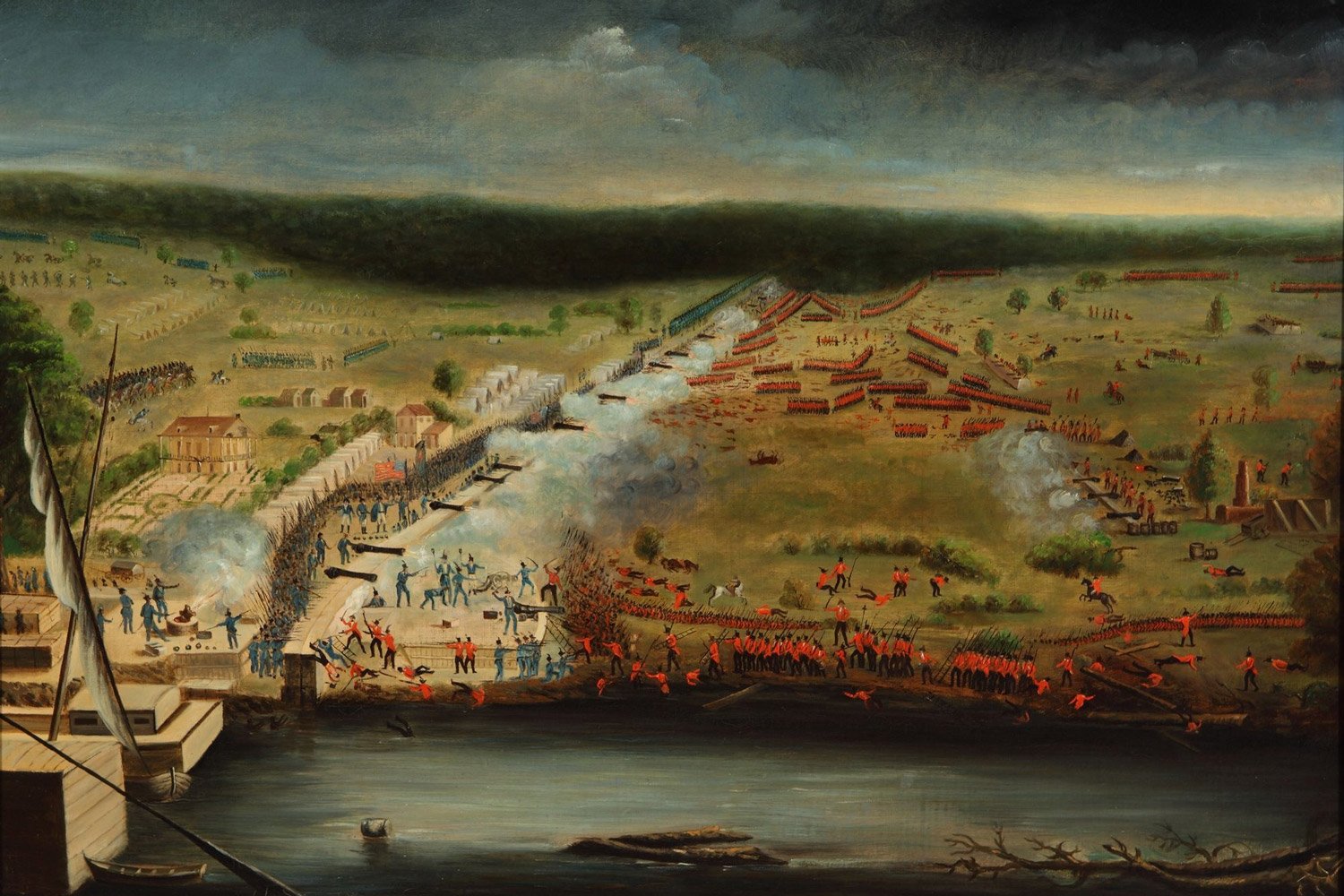
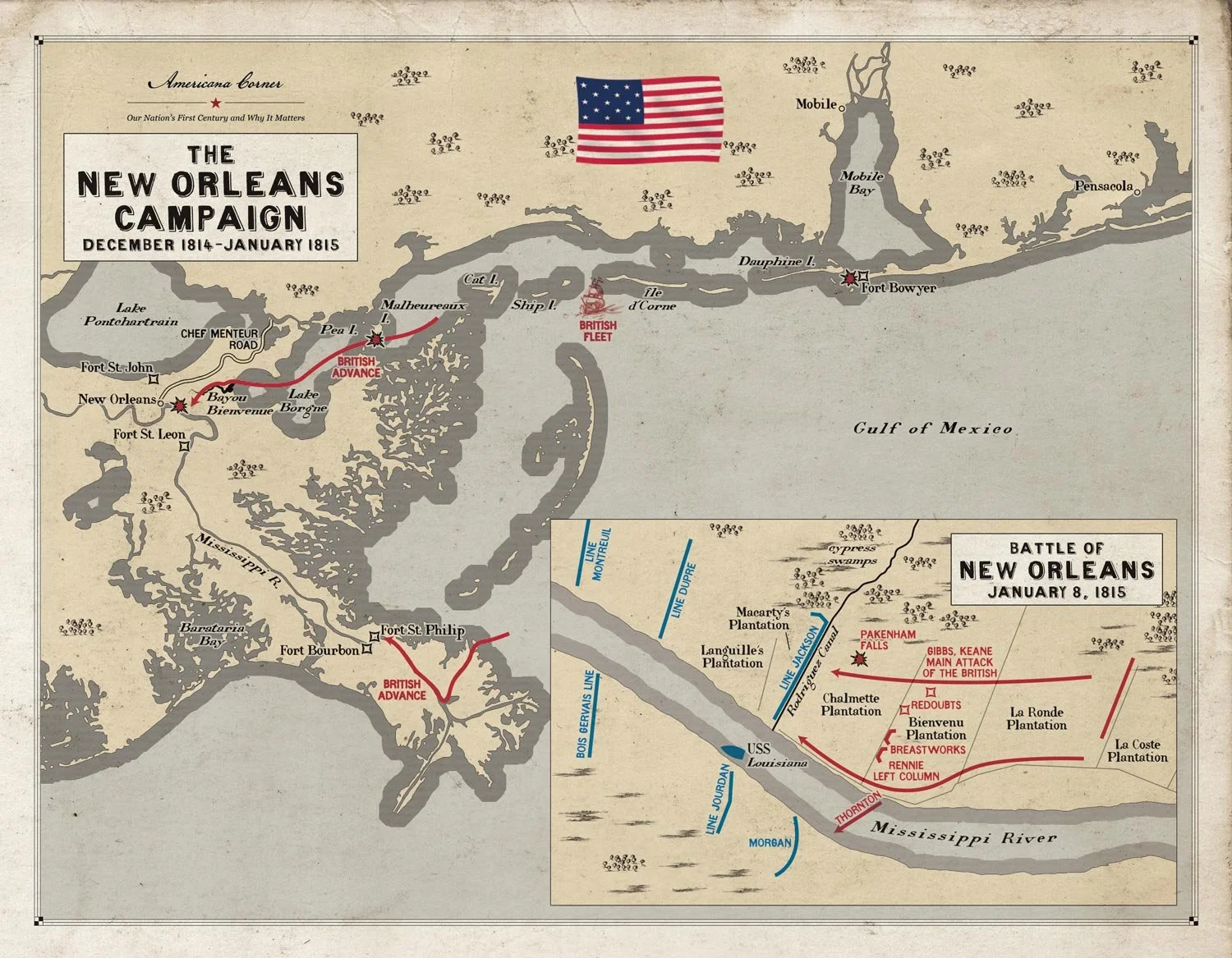
The Battle of New Orleans was really a series of four fights, three of which were already in the books: Jackson's surprise attack on December 23, the failed British assault on December 28, and the artillery duel on New Year's Day. But the one that has been taught to generations of Americans and is best remembered was the fatal attack by British General Sir Edward Pakenham on January 8, 1815.