
War of 1812, Part 40: British Descend on the Gulf
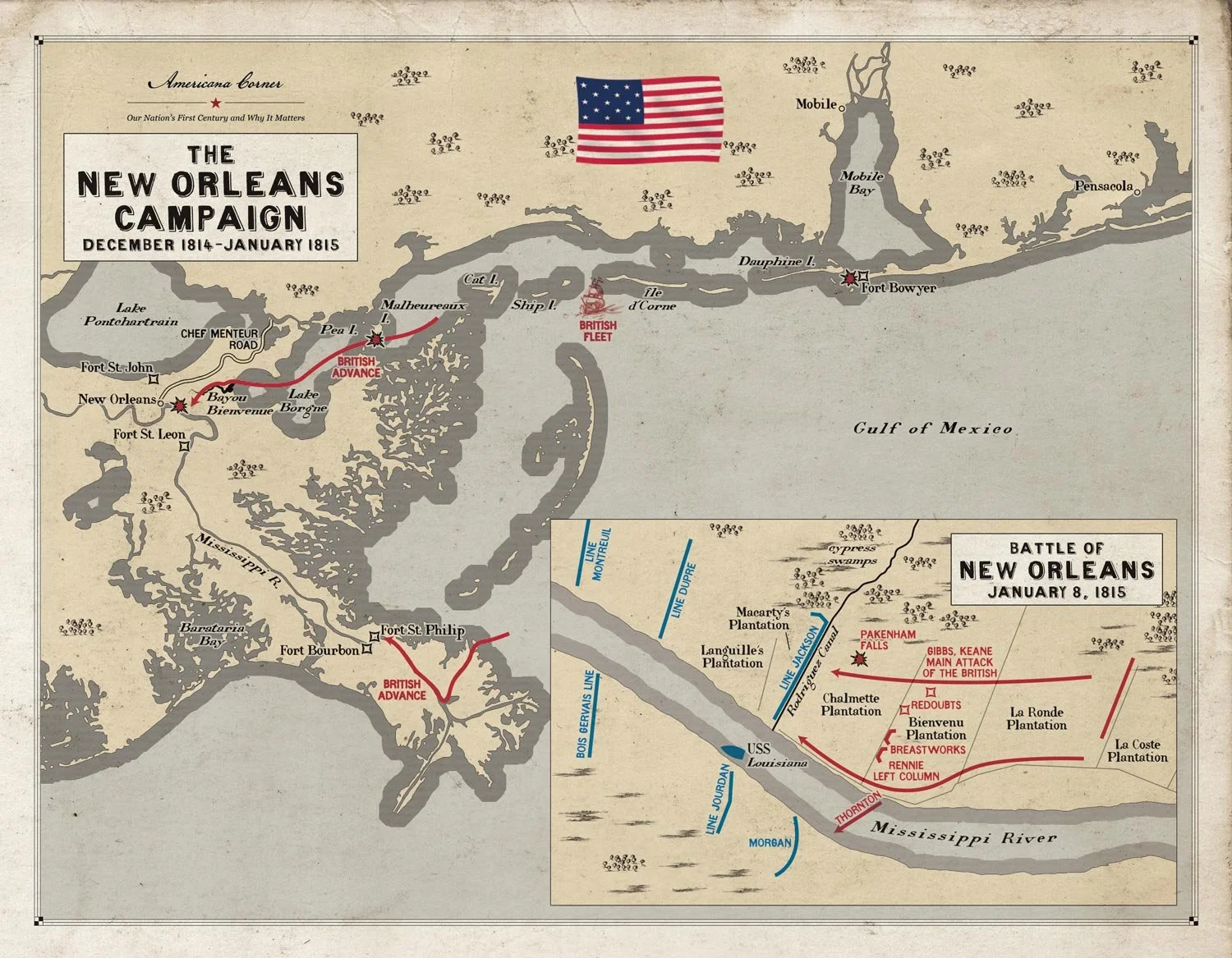
“The New Orleans Campaign Map.” Americana Corner.
In a dispatch dated August 10, 1814, Vice Admiral Alexander Cochrane was instructed by Lord Bathurst, Secretary of State for War and the Colonies, to proceed to Jamaica and rendezvous with reinforcements coming from England to assist him in capturing New Orleans. With the death of Major General Robert Ross at North Point, the War Department in London gave the command of the land force for this new expedition to Major General Sir Edward Pakenham, a veteran of the Peninsula War and the brother-in-law of the Duke of Wellington. And on November 26, Cochrane, Pakenham, and a British army of nearly 7,000 veterans sailed for New Orleans.
While the British were preparing for their descent on the Gulf, Americans were preparing to defend this strategically critical region. The commander of the 7th Military District, headquartered at Mobile, was Andrew Jackson, a recently minted Major General in the regular army who was tough as nails. Jackson was just a boy during the American Revolution (he was born in 1767) but served as a courier for the Continental Army. He was captured and imprisoned by the British after the Battle of Waxhaws and, while imprisoned, received a saber blow to the head from a British officer when Jackson refused to polish his boots. During the war, Jackson lost both his older and younger brothers and his mother, who died from cholera after nursing American prisoners in Charleston, leaving Jackson an orphan with an inveterate hatred of the British. Jackson received his commission after Major General William Henry Harrison, the hero of the Battle of the Thames, resigned from the army in May following a disagreement with Secretary of War John Armstrong. With Jackson's successful conclusion of the Creek War fresh in Armstrong's mind, Old Hickory seemed like the logical choice to defend the Gulf Coast.
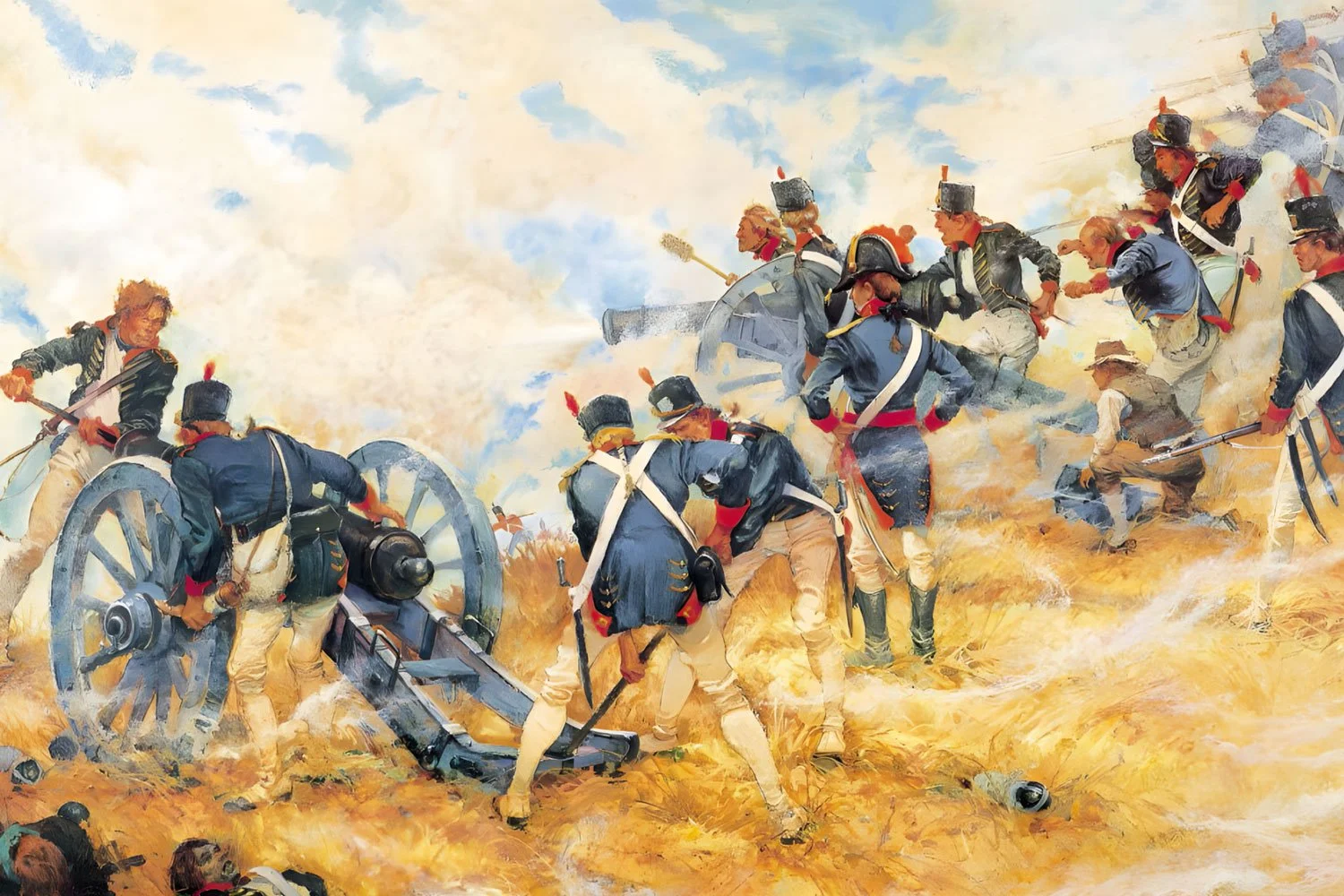
Jackson took command on August 15 and immediately worked to strengthen the defenses of Fort Bowyer, which guarded the entrance to Mobile Bay, convinced that any attack on New Orleans must come through Mobile, and Jackson held to this mistaken belief almost until the British appeared in front of New Orleans. Jackson's preparations at Fort Bowyer soon paid dividends when a British force from Pensacola under Lieutenant Colonel Edward Nichols, supported by four Royal Navy warships, attacked the fort on September 15. The 120-man garrison, commanded by Major William Lawrence, delivered a bloody repulse to the British, forcing Nichols to retire to Pensacola after suffering 162 killed and 72 wounded while the Americans suffered only 8 casualties.
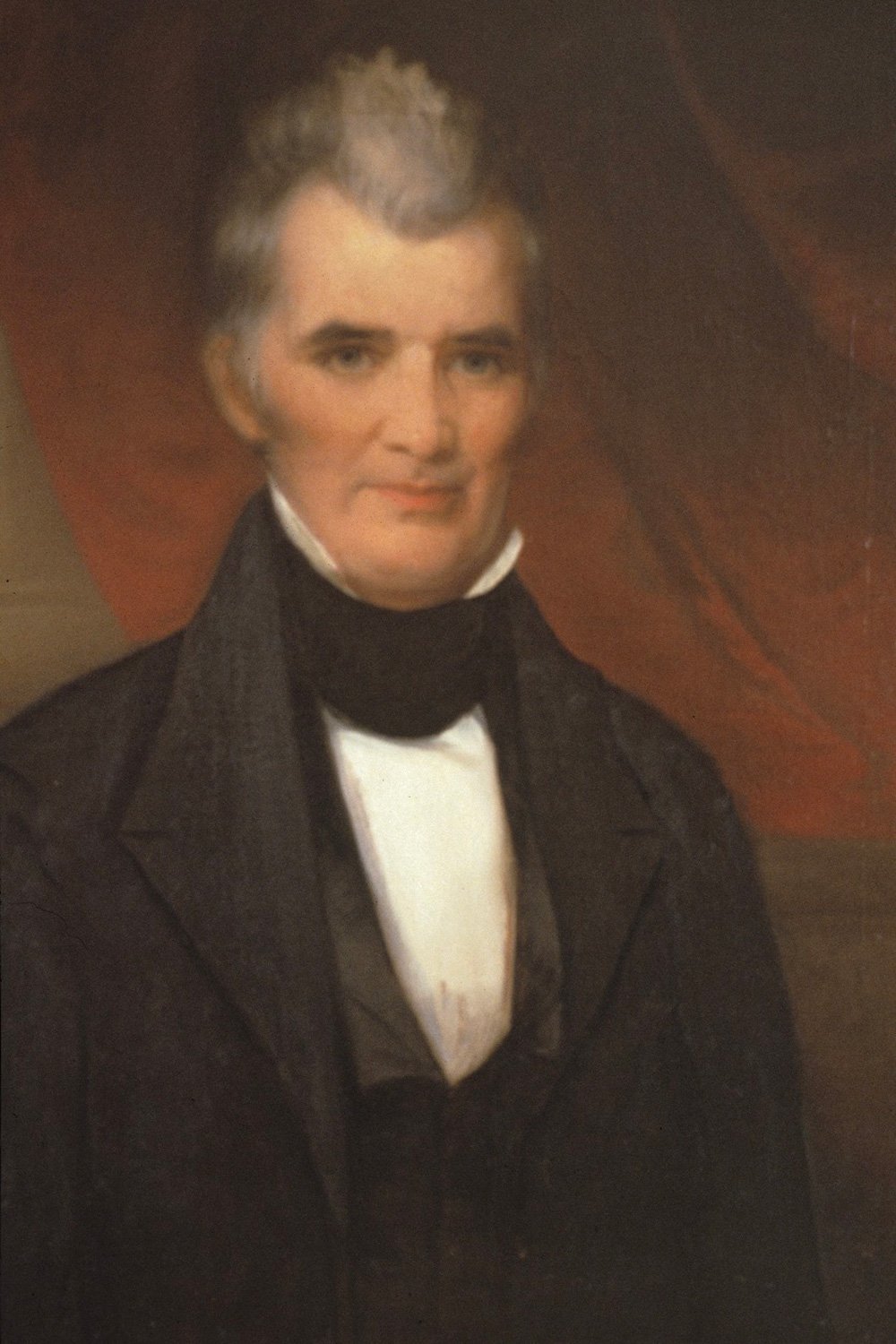
“Portrait of Sam Houston.” Wikimedia.
Jackson was now convinced that he should take the fight to the British and began preparations to lead an attack on the Spanish port city of Pensacola, sixty miles to the east. But the problem was that the United States was not at war with Spain, and invading the territory of a sovereign neutral nation was a desperate step, one strongly opposed by the Madison administration. On October 21, after Jackson informed him of his plans, James Monroe, the new Secretary of War (incredibly, Monroe was also Secretary of State), wrote to Jackson forbidding him to attack Pensacola, stating the President had no wish to become embroiled in a war with Spain. Moreover, Monroe urged Jackson to focus more on New Orleans, as, in the view of the administration, that city was the main goal of the British, calling Mobile a “comparatively trifling object with the British government.” Ignoring the order (Jackson claimed he never received it), Jackson moved forward with his plans and, on November 7, Jackson and his 3,000-man army captured the city. The Americans remained just a few days before marching back to Mobile, where Jackson remained for nearly two weeks, showing a surprising lack of urgency for the defense of New Orleans.
Jackson finally left Mobile for New Orleans on November 22, where he arrived on December 2 to find a city ill-prepared to withstand an assault, with only the 7th U.S. Infantry on station, plus a city militia force of 500 men. But more troops were on the way; the 44th Regiment was marching from Mobile, General John Coffee and 1,000 mounted Tennesseans were in Baton Rouge, a contingent of Tennessee volunteers commanded by General William Carroll was expected to arrive soon, and a division of Kentucky militia, 2,500 strong, was expected by the end of the year. Over the next two weeks, Jackson was a whirl of activity and inspected the defenses of the most likely approach routes of the British, including Fort St. Philip sixty miles below the city and the Chef Menteur Road and Lake Pontchartrain to the north. Jackson did not have soldiers to guard every approach to the city, and he waited anxiously for the British to show their hand. Finally, on December 14, while the General was inspecting the defenses to the north, the British struck their first blow.
The British expedition had arrived off Cat Island near the shallow waters of Lake Borgne on December 9, where they were confronted by six American gunboats guarding the mouth of the lake. Admiral Cochrane dispatched 1,000 sailors and marines under Captain Nicholas Lockyer in shallow-draft rowboats to destroy the Americans. The British finally caught up with the gunboats on December 14 and, after a stiff forty-five-minute fight, captured the small American fleet, inflicting forty-one casualties and taking eighty-six Americans prisoner. But the British suffered as well, as they lost several barges and had nineteen sailors killed and another seventy-five wounded.
From here, the British had two viable alternatives to approach New Orleans. The easiest route for the British was to sail through the Rigolets, an eight-mile tidal strait, into Lake Pontchartrain and land at Bayou St. John (a bayou is a slow-moving body of water or wetland) less than ten miles north of New Orleans. But because the ocean-going Royal Navy warships could not be used in these shallow inland waters, the British would have to row a tremendous distance to reach the landing site and pass under the guns of Fort Coquilles with little protection. Recognizing this was not a great option, Cochrane decided to proceed to the western end of Lake Borgne to Bayou Bienvenu and from there proceed west towards the city.
Next week, we will discuss the opening fight for New Orleans. Until then, may your motto be “Ducit Amor Patriae,” love of country leads me.
Hello America!
Subscribe to receive weekly complimentary articles and videos delivered straight to your inbox.

In a dispatch dated August 10, 1814, Vice Admiral Alexander Cochrane was instructed by Lord Bathurst, Secretary of State for War and the Colonies, to proceed to Jamaica and rendezvous with reinforcements coming from England to assist him in capturing New Orleans. With the death of Major General Robert Ross at North Point, the War Department in London gave the command of the land force for this new expedition to Major General Sir Edward Pakenham, a veteran of the Peninsula War and the brother-in-law of the Duke of Wellington. And on November 26, Cochrane, Pakenham, and a British army of nearly 7,000 veterans sailed for New Orleans.