
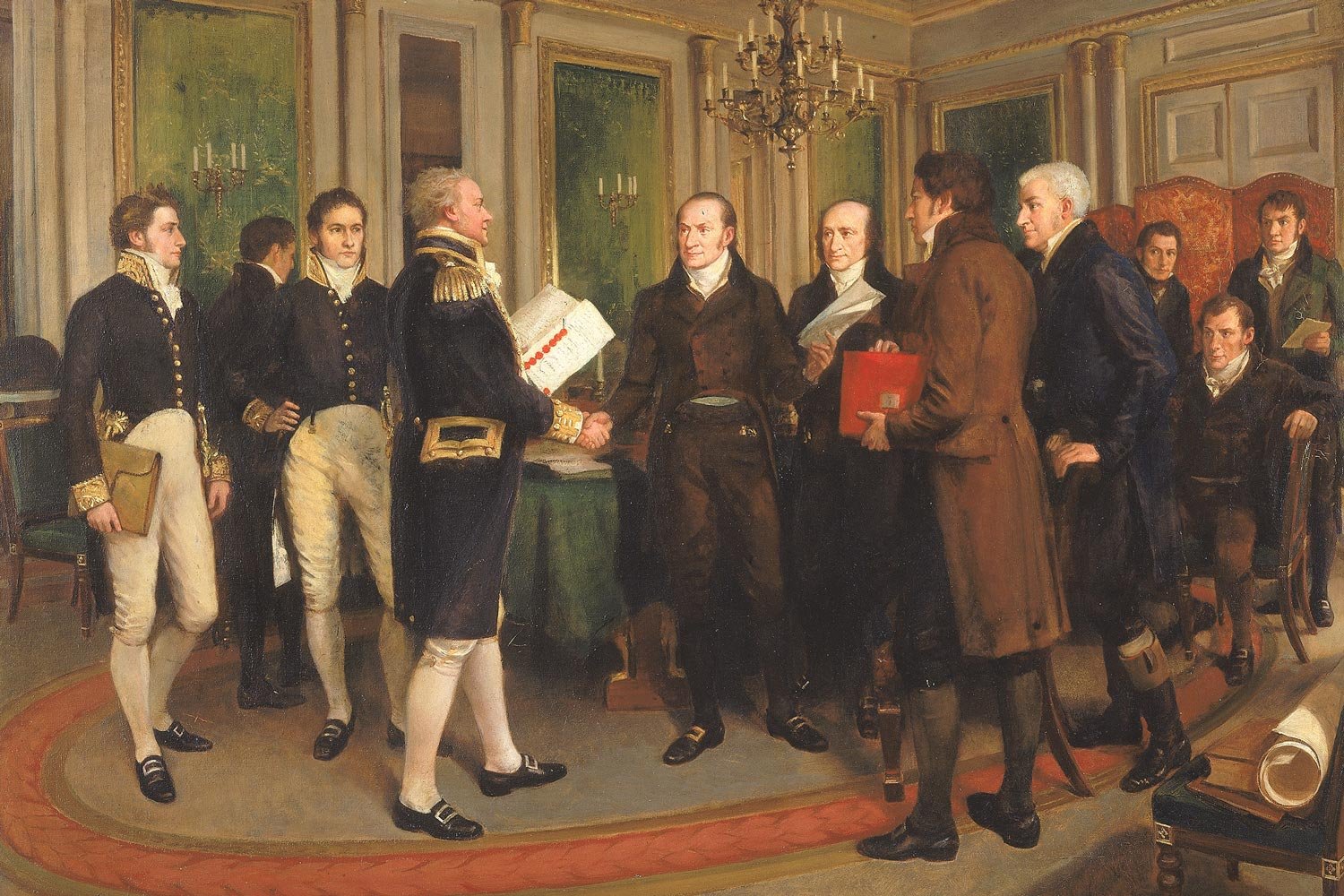
Sir Amédée Forestier. “The Signing of the Treaty of Ghent, Christmas Eve, 1814.” Smithsonian American Art Museum.
In March 1813, Czar Alexander I offered to mediate an end to the War of 1812, as the Czar wanted British attention and resources focused on defeating Napoleon and viewed the American war as simply a distraction. Russia, who enjoyed a prosperous trading relationship with the United States, was also feeling the economic pinch of the British blockade. Recognizing the war was not going well and costs were piling up on the financially strapped country, President James Madison speedily accepted and sent Senator James Bayard of Delaware and Albert Gallatin, the former Treasury Secretary, to join John Quincy Adams, the American Minister to Russia, in St. Petersburg to begin negotiations. But Lord Castlereagh, the British Foreign Minister, rejected the Russian mediation and, instead, offered to open direct negotiations with Washington in the Belgian city of Ghent. President Madison agreed to Castlereagh’s proposal and sent Henry Clay and Jonathan Russell to join the other three Americans.
The American team was formidable; Adams was the official head of the delegation and an experienced diplomat who would rise to become our nation’s most successful Secretary of State and later President; Gallatin was brilliant and perhaps the most capable Treasury Secretary ever other than Alexander Hamilton; Clay was Speaker of the House and destined to be one of the most successful statesmen in American history; Bayard was a well-respected United States senator and the only Federalist in the contingent; and Russell was the Charge d'Affaires in England. In contrast, the British delegation was a B-team of British diplomats led by Lord Gambier, who had no experience in diplomacy, and was joined by Henry Goulburn, a young Under Secretary of State, and William Adams, a Doctor of Civil Law, who took little part in the discussions.
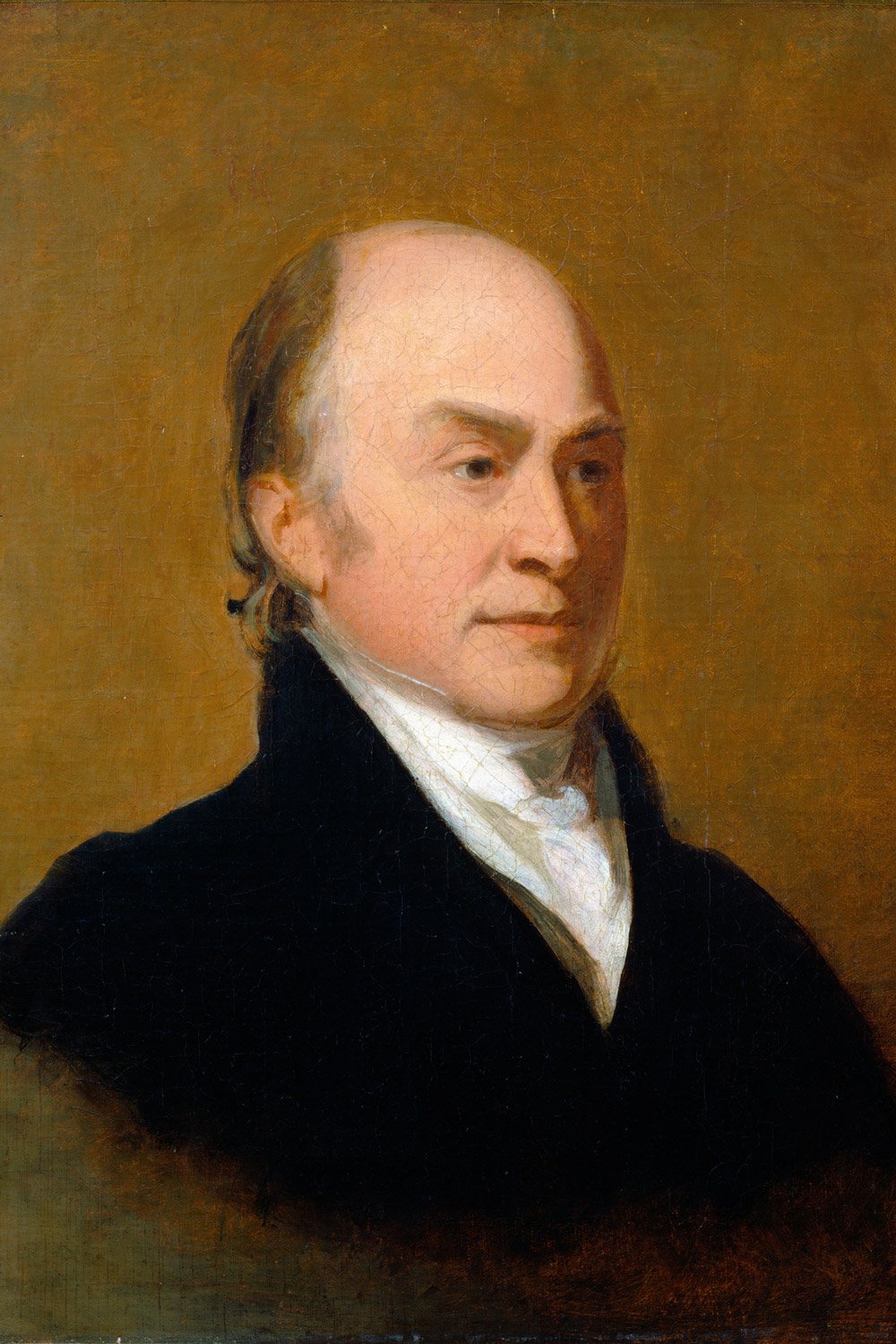
“John Quincy Adams.” Wikipedia.
The first meeting took place on August 8 at the Hotel des Pays-Bas, and the British made their initial demands known: a buffer zone for Indians formed from a significant portion of the original Northwest Territory, the cession to Canada of a portion of Maine, the prohibition of United States naval forces and land fortifications on the Great Lakes, navigational rights for the British on the Mississippi, and the revocation of the American right to land and dry fish in the Canadian maritime provinces. Goulburn further informed the Americans that the Indian territory was considered a sine qua non (an essential requirement) as the British planned to create a barrier between Canadian and American lands. Upon hearing these demands, Gallatin asked what was to become of the 100,000 American citizens already settled in the proposed Indian territory, and the British lightly responded that these Americans must shift for themselves.
The American response on August 25 was a dignified refusal of these unreasonable terms, stating, “They are above all dishonorable to the United States.” The Americans prepared to leave Ghent, and Goulburn notified his government that negotiations appeared to be at an end. But Lord Liverpool had no desire to extend the costly war and kept lines of communication open for the next two months while the country awaited news of General Prevost’s invasion up the Lake Champlain corridor. In mid-September, the British withdrew their demand for an Indian territory and exclusive control of the Great Lakes, and a glimmer of hope entered the discussions. About the same time, the American delegation received a letter from Secretary of State James Monroe authorizing the Americans to drop impressment as a requirement for peace, a significant concession given impressment was the primary reason the country went to war. But, in a nod to common sense, President Madison knew that with the war in Europe over, the number of sailors needed for Royal Navy ships was greatly reduced, and that impressment promised to become an obsolete issue.
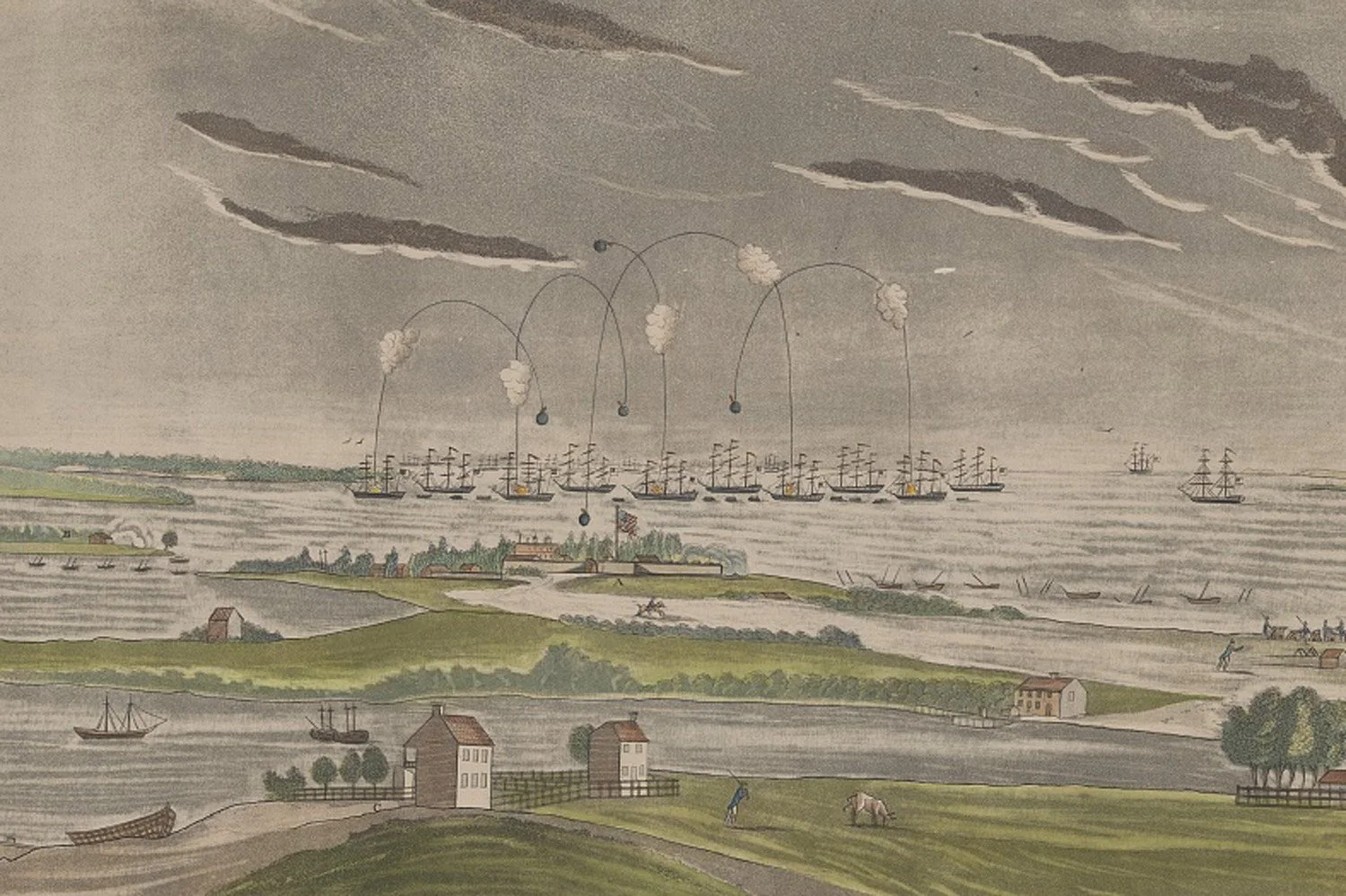
The next sticking point was upon which basis to end the war, by status quo ante bellum, in which things revert to how they were before the war, or uti possidetis, in which each country keeps territory gained or possessed during the war. The British were holding out for uti possidetis, anticipating a great victory by General Prevost and the capture of most of northern New York State to add to lands the British already occupied in Maine. But that all changed in mid-October when the shocking news was received in London that the Americans had turned back the British army outside Plattsburgh and Prevost had retired within the boundaries of Canada. That loss, combined with the failure to take Baltimore and the repulse of General Edmund Drummond at Fort Erie along the Niagara frontier, plus the recognition that the American war would cost as much as £10,000,000, made Lord Liverpool reconsider the British position.
On November 4th, Lord Liverpool wrote to the Duke of Wellington asking him for his thoughts on the British position. The Iron Duke replied, “In regard to your present negotiations, I confess that I think you have no right, from the state of war, to demand any concession of territory from America…You have not been able to carry it into the enemy's territory and have not even cleared your own territory on the point of attack.” With this stark reminder of the true state of affairs in America, Lord Liverpool decided to abandon Great Britain’s claim for territory in the peace treaty.
The final issues to be negotiated were the continued right of Americans to access Canadian fisheries and the right of British vessels to navigate the Mississippi. These matters were perhaps the most challenging for the Americans, as they caused a split within the delegation. While Adams fiercely defended the right of New Englanders to access the waters off the Maritime Provinces, much as his father had demanded these rights in the 1783 Treaty of Paris, Henry Clay, the devoted westerner, resisted any acknowledgement of the British right to navigation on the Mississippi. Gallatin proved to be the voice of reason, and after several letters between him and the British commissioners, it was agreed that the two contentious issues would simply be ignored for now but left open for future discussions.
And with that, the terms leaving things as they were before the hostilities were agreed to and the Treaty of Ghent signed by both sides on December 24, 1814, closing an era in American history.
Enjoyed this article? Share it to help others discover the great American story! Subscribe to receive a new article and video each week, delivered directly to your inbox.
Next week, we will discuss final thoughts on the War of 1812. Until then, may your motto be “Ducit Amor Patriae,” love of country leads me.
Hello America!
Subscribe to receive weekly complimentary articles and videos delivered straight to your inbox.
In March 1813, Czar Alexander I offered to mediate an end to the War of 1812, as the Czar wanted British attention and resources focused on defeating Napoleon and viewed the American war as simply a distraction. Russia, who enjoyed a prosperous trading relationship with the United States, was also feeling the economic pinch of the British blockade. Recognizing the war was not going well and costs were piling up on the financially strapped country, President Madison speedily accepted and sent Senator James Bayard of Delaware and Albert Gallatin, the former Treasury Secretary, to join John Quincy Adams, the American Minister to Russia, in St. Petersburg to begin negotiations.