
War of 1812, Part 19: The Origins of the United States Navy
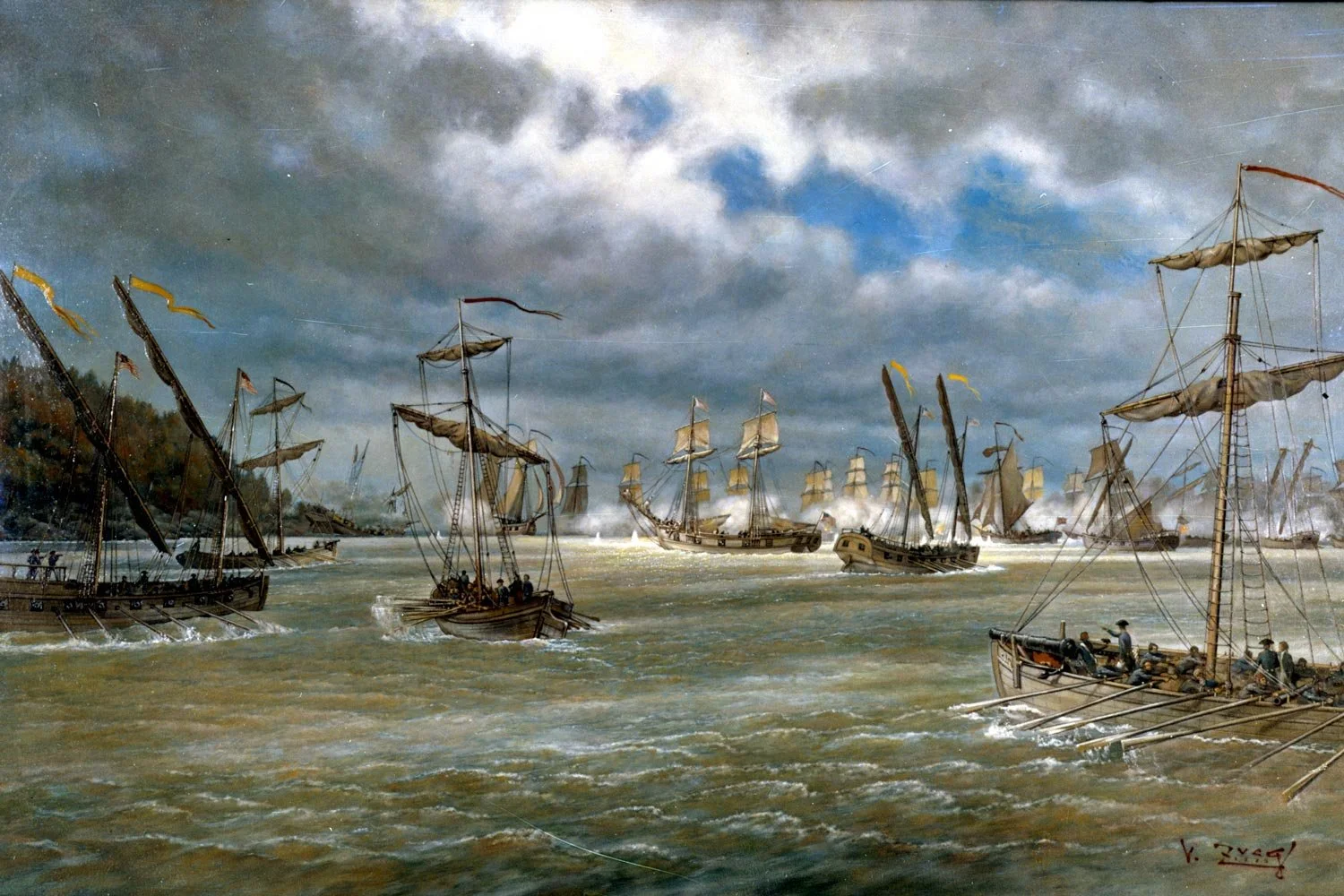
V. Veg. “Battle of Valcour Island.” Naval History and Heritage Command.
The United States Navy that performed so well in the War of 1812 can trace its roots to October 13, 1775, for on that memorable day the Continental Congress passed a resolution that created the Continental Navy. This law authorized the purchase of two merchant vessels to be converted into warships, the first of which was USS Alfred, commissioned on December 3, and named after the 9th-century English monarch Alfred the Great. Then, on December 22, Commodore Esek Hopkins stood on the deck of Alfred as Lieutenant John Paul Jones ran up the Grand Union flag, and the U.S. Navy went to sea.
The primary duty of our early Navy, in the words of the Congressional resolution, was “for intercepting such transports as may be laden with warlike stores and other supplies for our enemies”; in other words, disrupt British commerce and seize war materials, and our sailors proved to be especially adept at this task. In 1776 alone, Americans captured 342 British merchant ships and the precious cargoes they held, including military stores that supplied the Continental Army. Many of these captures were made by privateers, private citizens with letters of marque authorizing them to seize British vessels for profit. During the war, over 2,000 privateers were commissioned by Congress and various states, and it is estimated that these private warships captured over 2,200 British merchantmen valued at $60 million.
While our “official” Navy never entertained hopes of fully competing on the high seas against the British fleet, the strongest in the world, Congress took what measures they could. By the end of 1775, Congress authorized the construction of an additional thirteen frigates designed specifically for warfighting rather than continuing to refit merchantmen. Unfortunately, only eight frigates ever made it to the open ocean, as five were either scuttled to prevent their capture or unable to evade the British blockade. While the eight frigates that went to sea had some degree of success, all were eventually either captured or destroyed by the Royal Navy, which consisted of over 250 warships. Perhaps more importantly, compared with their British counterparts, American crews were relatively untrained and inexperienced in naval warfare, and their commanders were no exception. Not surprisingly, there were several setbacks during the war, the most significant of which was the failed Penobscot Expedition in 1779, the worst naval disaster in U.S. history until Pearl Harbor. However, although outnumbered and underequipped, there were numerous instances of American warships and fighting men performing well during the war, including a raid on Nassau in the Bahamas on March 3, 1776, by Continental Marines led by Captain Samuel Nichols, the Corps’ first commissioned officer. This first-ever amphibious landing in Marine Corps history captured two forts and a large quantity of military stores, including gunpowder and cannons, and gave a taste of the spirit shown by U.S. Marines for over two centuries.

“Benedict Arnold.” Brown University Library.
Interestingly, the most significant naval battle in the war did not occur on the high seas but rather on Lake Champlain in upstate New York. In a prelude to the great lake battles of the War of 1812, the Battle of Valcour Island, the navy’s equivalent of Bunker Hill, took place in the fall of 1776. The American fleet, which consisted of fifteen vessels, mostly small gunboats, was created and commanded by Benedict Arnold, one of the greatest American battlefield leaders in the war. Arnold commanded the rearguard of the American army retreating from Canada and his primary mission was to delay the British advance long enough for the main American army to strengthen Fort Ticonderoga and Crown Point, two forts at the southern end of Lake Champlain.
To counter Arnold’s fleet, General Guy Carleton, Governor of the Province of Quebec, had spent the previous three months at Fort St. John building a squadron capable of transporting his 10,000-man army across Lake Champlain en route to the upper Hudson River Valley. When the fleets finally engaged on the afternoon of October 11, 1776, Arnold’s little navy fought bravely and performed well but was largely destroyed by Carleton’s much larger flotilla. However, although the Battle of Valcour Island was a tactical defeat, it was a strategic victory as the Americans succeeded in delaying the British long enough to force their retreat to Canada before the onset of the harsh New York winter.
But the most illustrious naval Captain to emerge from the war was undoubtedly John Paul Jones, considered by many the Father of the American Navy. Born John Paul in 1747, he went to sea at the age of 13 but fled to America in 1772 to avoid a trial for killing a mutinous sailor (he had also recently flogged a sailor so severely that the sailor died from his wounds) and changed his name to John Paul Jones. When war broke out, Jones volunteered to serve in the Continental Navy and was appointed Lieutenant of the USS Alfred in 1775. He was soon given command of his own ship, USS Providence, and led numerous raids, including one in September 1776 on Canso, Nova Scotia, where he destroyed fifteen British merchant ships and pillaged several local communities.
The following year, Jones was given command of USS Ranger and took the war to British home waters in the spring of 1778, terrifying British shipping in the English Channel and the Irish Sea and even trying to kidnap and ransom the Earl of Selkirk (he missed the Earl but took his silver). The highlight of Jones’s cruise occurred on April 24, 1778, when Ranger captured HMS Drake following an hour-long single-ship combat off Carrickfergus in northeast Ireland, the first American victory in British waters over a Royal Navy ship.
But the fight for which Jones is most remembered took place after he was given command of a 42-gun French warship, which Jones renamed USS Bonhomme Richard in a nod to Ben Franklin’s Poor Richard’s Almanack. On September 23, 1779, Jones and Bonhomme Richard captured the British frigate HMS Serapis after a four-hour slugfest off Flamborough Head. It was during this combat, when all hope for the American ship was seemingly lost and Jones was asked to surrender, that he uttered those immortal words, “I have not yet begun to fight,” establishing the standard for American naval gallantry and courage under fire.
Next week, we will discuss the U.S. Navy coming of age. Until then, may your motto be “Ducit Amor Patriae,” love of country leads me.
Hello America!
Subscribe to receive weekly complimentary articles and videos delivered straight to your inbox.

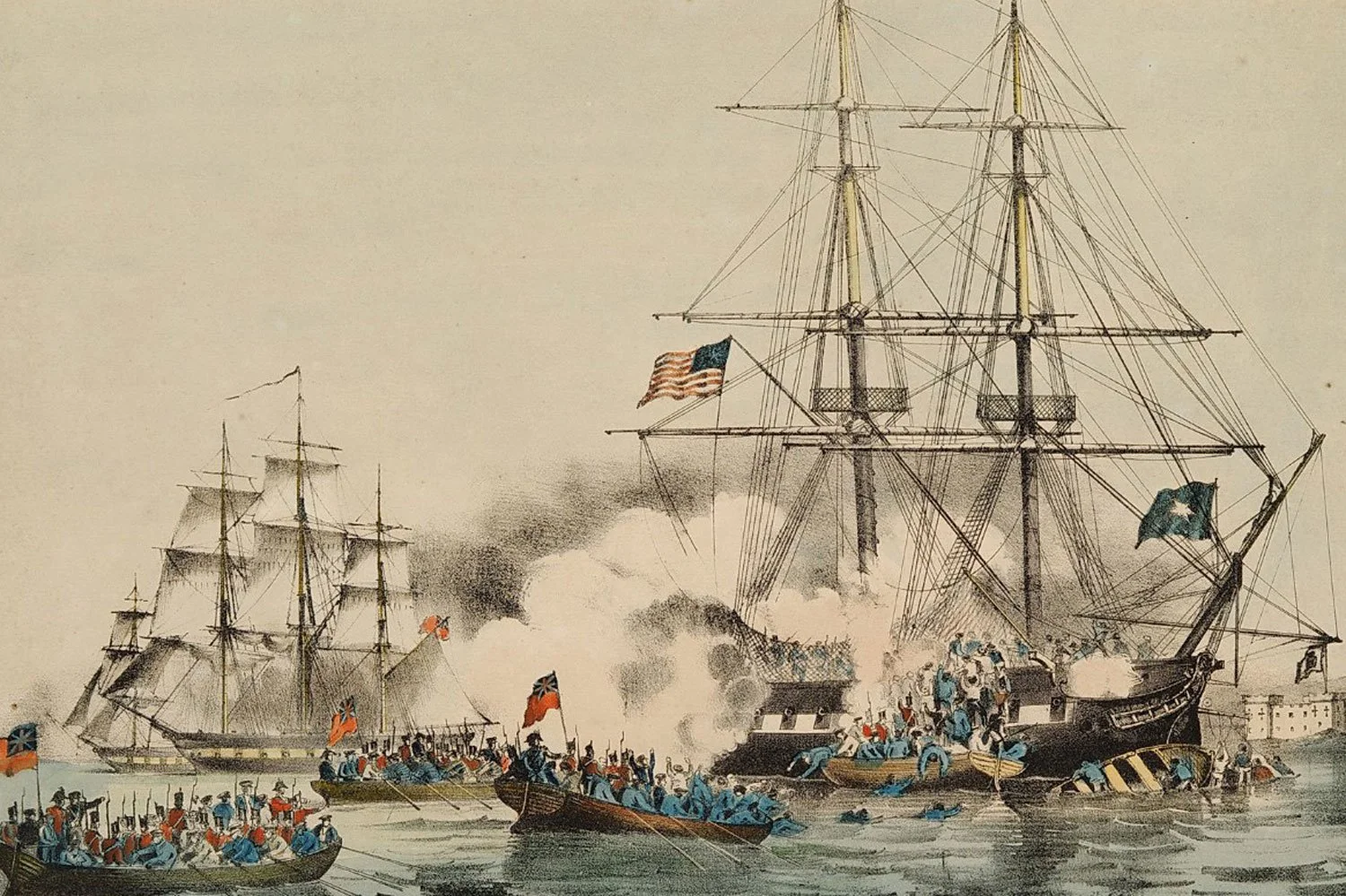
Many Americans, especially those in the Deep South, had cast covetous eyes towards Florida since the Treaty of Paris in 1783 ended the American Revolution and Spain regained the territory. Not surprisingly, when war was declared on Great Britain in 1812, one of the main goals of Southerners and President James Madison was to use the war as a pretext for obtaining possession of Florida from a decaying Spanish empire. The most contentious portion was the present-day panhandle of Florida, lower Alabama, lower Mississippi, and eastern Louisiana, an area known as West Florida.